

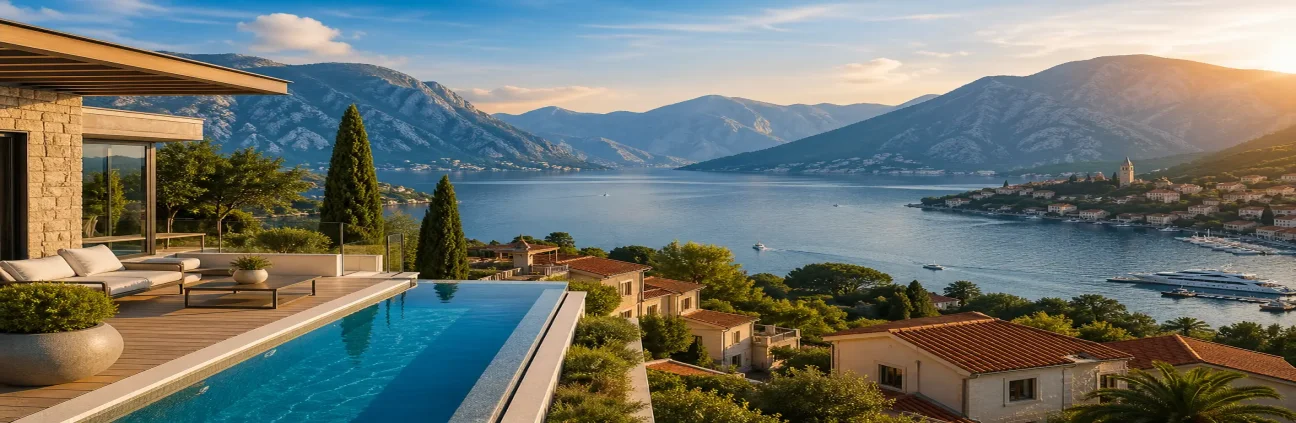


In recent years, Montenegro has emerged as one of the countries on the radar of those looking to invest in real estate abroad. In particular, the opportunity to generate euro-denominated income, the growing tourism potential in coastal cities, and a real estate market open to foreigners have made Montenegro an attractive investment destination. So, is buying a home in Montenegro really a sound decision as of 2026, or is this just a passing trend?
The answer to this question isn’t a simple “yes” or “no.” Because real estate investment in Montenegro can yield significant returns with the right city, budget, and strategy, but it can also turn into an average investment with the wrong choices. In particular, the rapidly rising prices in coastal regions in recent times make it essential to make more informed decisions when investing.
In this article, we will examine the current state of Montenegro’s real estate market in 2026, home prices, rental yields, and the balance of pros and cons from an investment perspective in detail. If you’re wondering, “Is buying a home in Montenegro a good idea?” this analysis will help you reach a clear decision.
What Is the State of Montenegro’s Real Estate Market in 2026?
As of 2026, Montenegro’s real estate market is dynamic and growing, particularly driven by demand from foreign investors. Despite the country’s small land area, its tourism potential and proximity to Europe keep real estate demand consistently strong. This situation has naturally led to rising prices in recent years.
The post-pandemic rise in trends such as “living abroad” and “remote work” has brought countries like Montenegro—which offer both lifestyle and investment opportunities—to the forefront. While a noticeable increase in property values is expected in coastal cities between 2024 and 2026, a more balanced price structure persists in inland regions. This offers investors both high returns and affordable entry opportunities simultaneously.
Which regions stand out?
When investing in Montenegro, the choice of city is one of the most critical factors directly affecting returns.
- Budva: The heart of tourism. One of the strongest locations for short-term rentals (Airbnb). It offers high income potential during the summer season.
- Kotor: Due to its historical architecture and limited development, supply is low and demand is high. This drives prices upward and ensures long-term appreciation.
- Tivat: The hub of the luxury segment. Projects around the marina specifically target high-budget investors and offer premium rental returns.
- Podgorica: As the capital, it has a more stable market and attracts long-term tenants. It offers a less tourist-oriented but more balanced investment.
Looking at the overall picture, Montenegro’s real estate market still holds growth potential in 2026. However, this growth is not at the same pace across all regions. Therefore, the answer to the question “Is buying a home in Montenegro a good idea?” largely depends on which city the investment is made in.
Real Estate Prices in Montenegro (Current Ranges as of 2026)
One of the topics that those considering buying a home in Montenegro are most curious about is prices. As of 2026, real estate prices across the country vary significantly depending on the region, location, and type of housing. There is a particularly noticeable price difference between coastal cities and inland regions.
To provide a general average:
- Average prices: 2,000€ – 4,000€ / m²
- Coastal and tourist areas: €3,500 – €6,000 / m²
- Luxury projects (especially around marinas): 6,000€ – 8,000€+ / m²
These figures show that Montenegro remains more affordable compared to many European countries. However, the rapid increase in recent years underscores the importance of buying at the right time and in the right location.
What Can You Buy in Montenegro for 100,000€?
This budget still allows you to enter the market in Montenegro. However, expectations need to be properly managed.
With a budget of around 100,000€:
- Small apartments in areas far from the city center
- Homes in older buildings requiring renovation
- Studio or 1-bedroom apartments in coastal cities
- Opportunity investment properties in developing areas
can be found.
If your goal is high rental returns, an apartment purchased within this budget can offer significant potential in the right location. Especially in tourist areas, small-square-meter homes can achieve high occupancy rates in short-term rentals.
In summary:
Home prices in Montenegro are still at a level where it’s not too late to invest. However, the market is no longer as cheap as it was in the early years. Therefore, when investing, it’s much wiser to proceed by asking, “Where will it yield the highest return?” rather than simply thinking, “I found it cheap, so I’ll buy it.”
Advantages and Disadvantages of Buying a Home in Montenegro
Buying a home in Montenegro has become particularly attractive for foreign investors in recent years. One of the main reasons for this is that rental income is denominated in Euros. From the perspective of a country like Turkey, where currency fluctuations are intense, earning a steady income in Euros offers a significant advantage in preserving the value of the investment.
Additionally, Montenegro is a country with a very active tourism sector. Especially during the summer months, demand for accommodations in coastal cities like Budva and Kotor increases significantly. This situation translates to high occupancy rates and, consequently, higher income for investors engaged in short-term rentals. A home purchased in the right location can cover a large portion of the annual rental income during the season.
Another key advantage is that purchasing real estate in Montenegro is relatively straightforward for foreigners. Property registration processes proceed more quickly compared to many European countries and involve less bureaucracy. Additionally, owning real estate provides an advantage when applying for residency permits. This makes Montenegro more appealing not only for investors but also for those considering an alternative lifestyle.
On the other hand, despite these advantages, certain risks should not be overlooked. In particular, due to rising demand in recent years, prices in some regions have risen rapidly. This can lead to some properties being priced above their true value. A purchase made at the wrong price level may fail to deliver the expected return.
Additionally, since Montenegro is a small market, liquidity is not always high. In other words, selling a property at the right time and price is not always as easy as buying it. Therefore, a more planned and medium-to-long-term perspective generally yields healthier results than short-term buy-and-sell strategies.
Finally, the most critical factor is location selection. The most common mistake made when investing in real estate in Montenegro is making decisions based solely on price. However, rental income and value appreciation depend largely on location. Investments made in areas with no tourist demand or low development potential may not deliver the expected performance.
When all these factors are considered together, buying a home in Montenegro can be a sensible option for many investors. However, for this decision to yield the right results, it is entirely dependent on proper analysis and the right choice.
Who Should Buy a Home in Montenegro?
Buying a home in Montenegro is not an equally sensible investment for everyone. Whether this investment will actually be profitable depends directly on the investor’s goals and expectations.
First and foremost, Montenegro is a highly suitable market for investors seeking a steady rental income. Especially in tourist areas, it is possible to generate high seasonal income through short-term rentals. If a property is purchased in the right location and managed professionally, annual returns can reach levels more satisfying than those in many European countries.
Additionally, Montenegro is an attractive alternative for those considering both lifestyle and investment plans. A more peaceful life, proximity to Europe, and relatively lower living costs offer significant advantages, particularly for remote workers and digital nomads. Similarly, for those planning for retirement, Montenegro has become a viable option in terms of both quality of life and cost-effectiveness.
Investors aiming for long-term value appreciation can also find opportunities in Montenegro. Factors such as the country’s status as an emerging market, ongoing infrastructure investments, and the European Union accession process support the potential for real estate values to rise over time. However, such an investment requires patience and avoiding short-term expectations.
Conversely, Montenegro may not always be a suitable market for investors aiming to make quick profits through rapid buy-and-sell transactions. Due to the small size of the market and the limited pool of buyers, sales processes can take time. Therefore, it stands out as a more appropriate option for investors who act in a planned and strategic manner.
In summary, buying a home in Montenegro can be a sensible choice for those seeking rental income, those planning an alternative lifestyle, and those considering long-term investments. However, for this investment to be successful, expectations must be properly defined, and the strategy must be built accordingly.
Final Verdict for 2026: Should You Buy a Home in Montenegro?
Looking at the Montenegro real estate market as of 2026, it still appears to offer opportunities from an investment perspective. Increasing foreign demand, tourism potential, and the advantage of Euro-based income are among the key factors making this market attractive.
However, the key point here is not whether buying a home in Montenegro is “generally a good idea,” but whether it is the right investment for you. Because two different investments made within the same market can yield completely different results.
An investment made in the right city, at the right price level, and for the right purpose can deliver strong performance in terms of both rental income and appreciation. In particular, well-informed investments in tourist areas have the potential to pay for themselves in a short period.
Conversely, a purchase made solely on the idea of “owning a home abroad” without proper analysis may fail to deliver the expected returns. Therefore, conducting market research, making the right location choice, and seeking professional guidance if possible are of great importance during the decision-making process.
In conclusion, buying a home in Montenegro remains a sound investment option as of 2026. However, this soundness only translates into real profit when combined with the right strategy. Otherwise, there is always the risk that it will remain just an ordinary investment.
When making a decision, the most important question should be:
Why am I making this investment, and what do I hope to achieve?
Once you clarify the answer to this question, you’ll be able to assess much more accurately whether buying a home in Montenegro is truly a sound investment for you.

 +382 69 980 968